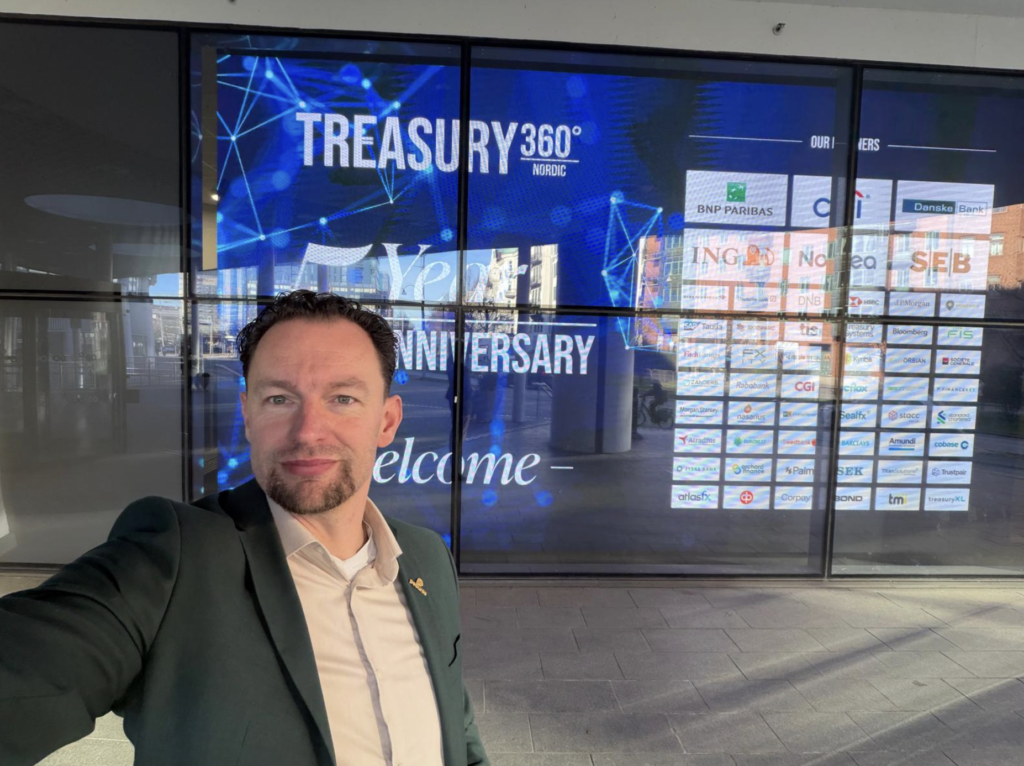
I joined Treasury 360 Nordic 2026 on Thursday in Gothenburg, and the format pretty much forces you into a reality every treasurer recognizes: you can’t attend everything, so you pick your battles and hope you chose wisely.
The agenda wasn’t built around one big headline theme. Instead, it was a mix of parallel sessions covering what treasury is currently wrestling with in real life. Slightly messy, but honestly more realistic than a perfectly structured conference narrative.
Real-time treasury is creeping into reality
Across multiple sessions, the idea of real-time treasury kept coming up; not in the overhyped vendor sense, but in grounded, practical conversations. The focus was on moving away from static daily reporting, increasing the frequency of cash visibility, and shortening decision cycles in a way that actually supports the business.
At the same time, there’s still a clear gap between ambition and reality. Many teams talk about real-time insight, yet continue to rely heavily on yesterday’s data. The result is an in-between state where processes are evolving, but not quite there, and where organizations often present themselves as further along than they truly are.
AI is finally being treated like a tool, not a miracle
AI showed up everywhere, as expected, but the tone has clearly shifted. Instead of vague promises, conversations focused on tangible use cases like improving forecasting, automating repetitive processes, and supporting decision-making rather than replacing it. In other words, AI is becoming… boring. Which is exactly what you want if it’s actually going to work.
Digital assets: less hype, more “maybe useful.”
Sessions around stablecoins and digital assets felt noticeably more grounded than a year ago. The discussions centered on cross-border payment efficiency, liquidity accessibility, and the practical challenges of integration. No one is about to overhaul their banking setup overnight, but the tone has moved from curiosity to cautious experimentation.
The treasury tech stack is a growing problem
Technology fragmentation came up repeatedly. Conversations revolved around TMS landscapes, integration with ERPs and banks, and the complexities of data flows and connectivity. Many treasury setups have grown organically into something… let’s call it “creative”. Lots of tools, but limited cohesion. While everyone wants automation, fewer are willing to tackle the underlying plumbing required to make it work.
Risk management is expanding beyond finance
Risk discussions no longer stayed neatly within FX or interest rates. They increasingly touched on geopolitical exposure, operational risks, and broader financial resilience. Treasury is being pulled into more strategic conversations, whether teams feel fully prepared for that shift or not.
Digitalisation is still the foundation (yes, still)
At its core, most sessions circled back to the same fundamentals: data quality, process standardisation, automation, and connectivity. It’s not new or particularly exciting, but it remains the determining factor for whether anything else can succeed.
The format: controlled chaos
The Thursday setup combines parallel sessions, short formats, and heavy networking in between. It’s not overly polished, but it works. Attendees build their own agenda on the fly, and a significant portion of the value comes from conversations happening outside the formal sessions.
Final takeaway
Thursday didn’t revolve around a single breakthrough idea. Instead, it pointed clearly to where things are heading: AI is becoming usable, digital assets are becoming testable, tech stacks are becoming unavoidable, and treasury’s role is expanding. Underneath all of this, one thing remains clear: data and connectivity are still the bottleneck. Everything else depends on how well that gets fixed.
If this sounds familiar, it’s probably because you’re dealing with it too. At Pecunia, we focus exactly on closing that gap, bringing clarity, connectivity, and real-time insight into treasury operations without the chaos.