Hollywood has reportedly spent around $600 million to bring Matt Damon home.
From Saving Private Ryan and The Martian to the Bourne films, audiences have jokingly pointed out that Hollywood seems to spend a fortune on bringing Matt Damon back safely. Now, with Christopher Nolan’s The Odyssey, the actor embarks on another legendary journey, this time as Odysseus, fighting his way back to Ithaca.
Fortunately, most organisations won’t ever have to finance an adventure on quite that scale.
Yet every treasury team is on its own odyssey every single day.
Not across the Mediterranean, but across an equally unpredictable landscape of changing markets, uncertain cash flows, volatile currencies, and shifting business priorities. The destination remains the same: ensuring the organisation has the liquidity it needs, where and when it needs it.
One of the reasons The Odyssey has remained relevant for thousands of years is that it isn’t simply a travel story. It’s a story about navigating uncertainty.
Odysseus never knew exactly what lay beyond the next horizon. Every decision carried consequences, every detour consumed precious resources, and every unexpected obstacle forced him to adapt.
Treasury operates in much the same way.
No forecast can predict every customer payment, every market movement, or every geopolitical event. The objective of cash flow forecasting has never been to eliminate uncertainty. It is to prepare for it.
A good forecast gives treasury the visibility to recognise potential challenges before they become problems. It allows organisations to test different scenarios, strengthen liquidity buffers, and make informed decisions instead of reactive ones.
The parallels with The Odyssey are surprisingly fitting.
- The storms represent market volatility and unexpected disruptions that can quickly change the course of a business.
- The Sirens resemble opportunities that appear attractive but may expose the organisation to unnecessary financial risk.
- Scylla and Charybdis reflect the difficult financing and investment decisions where every option involves trade-offs.
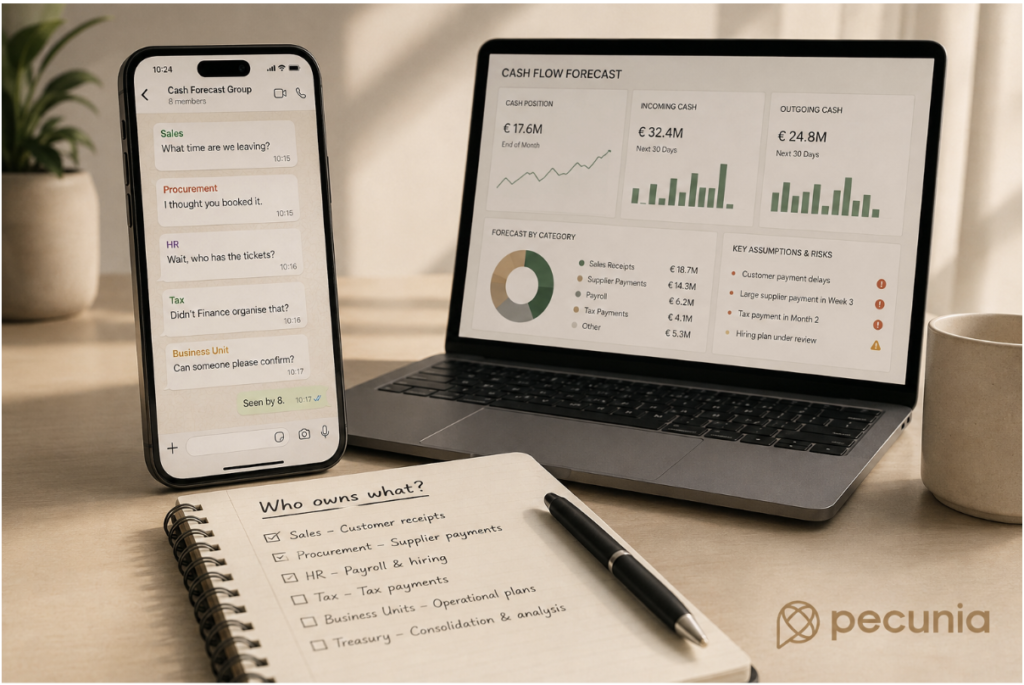
- The crew represents the wider finance organisation: FP&A, accounting, procurement, business units, and treasury; all working together toward the same destination.
- Ithaca symbolises confidence in your liquidity position: knowing the organisation can meet its obligations, fund its strategy, and navigate whatever comes next.
Perhaps the biggest lesson from Odysseus’ journey is that success was never about knowing exactly what would happen next.
The same principle applies to treasury. Cash flow forecasting is not a crystal ball designed to predict the future with perfect accuracy; it is a navigation system that helps organisations prepare for uncertainty. By providing direction, highlighting potential hazards, and enabling scenario planning, it gives decision-makers the confidence to adjust course before challenges become crises. In treasury, the destination is rarely reached by accident. The strongest treasury teams don’t simply hope they’ll reach their own Ithaca; they build the forecasts, visibility, and resilience needed to navigate whatever lies ahead.
Navigating Your Treasury Journey
Every organisation’s journey is different, but uncertainty is something every treasury team shares. The difference isn’t in avoiding every storm; it’s in having the visibility, expertise, and tools to navigate through them with confidence.
Whether you’re looking to strengthen your cash flow forecasting, improve liquidity visibility, implement a Treasury Management System, or prepare for your next treasury transformation, Pecunia Treasury & Finance helps organisations build resilient treasury functions that are ready for whatever lies ahead.
Because every treasury journey deserves more than hope – it deserves the right navigator.