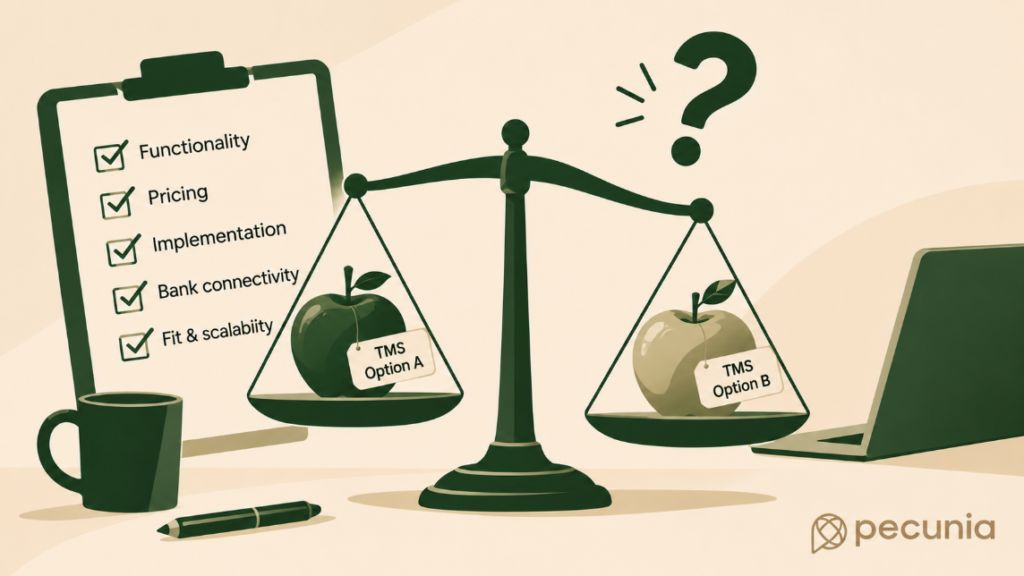
The Treasury Management System market offers more choice than ever, but for corporate treasurers, understanding what they are actually buying can still be surprisingly difficult.
Corporate treasurers are responsible for managing millions, sometimes billions, in cash, debt, investments, and financial risks. They regularly negotiate with banks, evaluate counterparties, challenge pricing structures and demand transparency from their financial partners.
Yet when it comes to selecting the technology that supports these responsibilities, obtaining the same level of transparency can be challenging.
The Treasury Management System (TMS) market offers an impressive range of solutions, from comprehensive enterprise platforms to specialized applications addressing specific treasury functions. The technology continues to evolve, providing organizations with opportunities to improve efficiency, visibility, and control.
However, this variety also makes comparisons increasingly complicated. Solutions may appear remarkably similar in vendor presentations and requirements spreadsheets, even when their underlying functionality, implementation requirements and commercial models differ significantly.
For treasury teams preparing to invest in a TMS, understanding these differences is essential to making an informed decision.
When Every Vendor Appears to Offer Everything
A quick review of TMS providers’ websites reveals a familiar set of capabilities. Cash visibility, liquidity forecasting, payments, bank connectivity, FX management, risk management, and reporting appear across many solutions. Automation, real-time insights, artificial intelligence, and seamless integration are also increasingly common selling points.
While these capabilities can offer considerable value, the terminology used to describe them does not always provide enough information to make meaningful comparisons.
For example, a particular forecasting feature might be available as standard functionality in one system, require extensive configuration in another, or depend on additional development in a third. All three providers could reasonably indicate that the functionality is supported, despite the differences in implementation effort, cost, and long-term maintenance.
The same applies to integrations, reporting capabilities and workflow automation. A feature’s availability tells only part of the story, particularly when the corporate’s operating environment introduces additional complexity.
A useful TMS comparison should therefore examine how functionality is delivered, how extensively it has been implemented in comparable organizations, and what resources are required to make it operational.
During the selection process, treasury teams should request a clear distinction between standard capabilities, configurable features, third-party dependencies, and custom development. Understanding these differences early can prevent unexpected costs and implementation challenges later.
Understanding the Real Cost of a TMS
Pricing transparency represents another challenge in the TMS selection process.
Most enterprise software providers operate with customized quotations, reflecting differences in organizational size, complexity, functionality and technical requirements. This approach is understandable, considering that a multinational corporation with hundreds of entities and complex global bank connectivity requirements will have very different needs from a smaller organization seeking basic cash visibility.
Nevertheless, customized pricing can make it difficult for treasury teams to understand the financial implications of different solutions before entering detailed commercial discussions.
Subscription fees may depend on the number of users, entities, bank accounts, transactions or modules. Additional charges may apply to bank connectivity, APIs, integrations, support, system environments and future expansions.
These cost structures can have important consequences as an organization grows. Acquiring new entities, expanding into additional countries or introducing new treasury processes may affect the overall cost of the system.
For this reason, a meaningful financial comparison should consider the total cost of ownership over several years, including implementation, internal resources, ongoing maintenance, support, and potential future developments.
Treasury teams can improve transparency by requesting detailed pricing breakdowns and asking vendors to explain how costs may change under different scenarios. A five-year cost projection, for example, can provide a more realistic basis for comparison than the initial subscription or implementation fee alone.
The objective is to understand which commercial model best aligns with the organization’s operational needs, growth expectations, and financial constraints.
Implementation: Where Expectations Meet Reality
The implementation phase is often where differences between TMS solutions become most apparent.
During the selection process, proposed timelines and implementation methodologies may appear straightforward. However, the complexity of a corporate treasury environment can introduce challenges that are difficult to anticipate fully.
ERP integrations may require additional development, bank connections may involve unexpected technical requirements, and historical data may need extensive cleaning before migration. Internal resources can also become a limiting factor, especially when treasury teams must manage implementation activities alongside their regular responsibilities.
As a result, projects can extend beyond their original timelines and budgets.
These challenges involve responsibilities on both sides. Vendors and implementation partners must provide realistic assumptions and communicate technical requirements, while corporate treasury teams must ensure that their processes, data and internal resources are sufficiently prepared.
A transparent implementation proposal should clearly define the scope of work, project responsibilities, required resources, technical dependencies and assumptions underlying the proposed timeline.
Treasury teams should also ask for examples of comparable implementations and seek to understand the circumstances that contributed to delays or additional costs.
Implementation experience and the quality of the proposed project approach deserve as much attention as the software’s functionality.
A system that meets every functional requirement may still represent a challenging investment if the organization lacks the resources or technical infrastructure needed to implement and maintain it effectively.
Bank Connectivity: Looking Beyond the Numbers
Bank connectivity is another area where apparently similar capabilities can involve very different technical and operational arrangements.
Some TMS providers highlight their ability to connect with large numbers of financial institutions. This can be a useful indication of connectivity coverage, although the practical relevance depends on the nature of those connections and the organization’s specific banking relationships.
An existing bank connection may support account statements but require additional work to enable payments or acknowledgements. Different connectivity channels, such as SWIFT, EBICS, host-to-host connections and APIs, may also involve different costs, maintenance responsibilities and technical requirements.
For treasury teams, the important consideration is whether the available connectivity supports their actual banking operations.
A comprehensive evaluation should establish which bank connections are already operational, which services and message formats are supported, and what additional configuration or development may be required.
It is equally important to clarify who will maintain these connections when banks introduce technical changes or new requirements.
A detailed connectivity assessment can help organizations identify potential implementation risks and ongoing costs before committing to a particular solution.
The Importance of Independent Advice
Given the complexity of TMS selection, many organizations involve external consultants and treasury advisers to support the process.
Experienced advisers can provide valuable market knowledge, help translate business requirements into technical specifications, and support the evaluation of competing solutions.
However, organizations should understand the commercial relationships and incentives of everyone involved in the selection process.
Some advisory firms maintain partnerships with technology providers, while others may offer implementation services alongside their selection advice. These arrangements are common across the enterprise technology market and do not necessarily compromise the quality or objectivity of the advice provided.
Nevertheless, transparency around such relationships helps corporate clients assess recommendations in the appropriate context.
Treasury teams should feel comfortable asking advisers about relevant commercial relationships, referral arrangements and their potential involvement in subsequent implementation activities.
Clear disclosure, documented evaluation criteria and a consistent assessment methodology can contribute to a more objective decision-making process.
Ultimately, the value of external advice depends on its ability to help an organization identify a solution that aligns with its particular requirements, resources and long-term strategy.
Why a Successful Demo Does Not Tell the Whole Story
TMS demonstrations are an important part of the selection process, offering treasury teams an opportunity to explore functionality and assess the user experience.
Modern systems can present impressive dashboards, automated workflows, advanced reporting capabilities, and sophisticated forecasting tools.
However, demonstrations are generally designed to showcase a solution under favorable conditions. The corporate environment in which the system will ultimately operate may involve additional complexity, including multiple ERP systems, inconsistent data, legacy integrations, local regulatory requirements and different processes across subsidiaries.
As a result, treasury teams should complement standard product demonstrations with practical scenarios reflecting their own operating environment.
For example, a demonstration could explore how the system handles missing bank statements, payment exceptions, changes in organizational structure or the onboarding of newly acquired entities.
For forecasting functionality, it may be useful to examine the entire process, from data collection and validation to forecast adjustments, approvals and reporting.
These scenarios can reveal how different solutions manage everyday treasury activities and where additional configuration, integration or manual intervention may be necessary.
Treasury teams should also distinguish between functionality currently available in the product and capabilities planned for future releases.
The most valuable demonstrations are those that help organizations understand how a solution will perform within their specific business environment.
This requires both the vendor and the corporate to invest time in preparing relevant use cases and agreeing on realistic evaluation criteria.
Corporates Also Have a Responsibility
Greater transparency in the TMS market requires effort from buyers as well as technology providers and advisers.
Corporate treasury teams sometimes approach system selection with extensive requirements lists in which nearly every feature is classified as essential. While comprehensive requirements are important, insufficient prioritization can make meaningful comparisons more difficult.
Organizations may also begin the selection process before fully documenting their existing processes, identifying internal stakeholders or defining the problems they want the technology to solve.
These gaps can lead to changing project scopes, inconsistent vendor quotations and unrealistic implementation expectations.
A successful selection process therefore begins with a clear understanding of the organization’s treasury strategy, operational challenges and future requirements.
Treasury teams should distinguish between essential functionality, desirable improvements and capabilities that may become relevant as the organization develops.
They should also evaluate their internal readiness, including data quality, process standardization, IT resources, and the availability of employees who will participate in the project.
Clear priorities and realistic expectations make it easier to assess solutions consistently and identify the trade-offs involved in each option.
A well-prepared organization is better positioned to engage in productive discussions with providers and obtain proposals that reflect its actual requirements.
A Changing Market Requires a Broader Perspective
The TMS market continues to evolve as established enterprise solutions compete alongside newer cloud-native platforms and specialist technology providers.
Organizations can now choose between comprehensive treasury platforms, specialized applications and combinations of technologies addressing different operational needs.
This development offers corporate treasurers greater flexibility, but also introduces additional considerations.
Some organizations may benefit from a single integrated platform covering multiple treasury functions. Others may prefer specialized applications that provide deeper capabilities in particular areas or complement existing systems.
The appropriate approach depends on factors such as organizational complexity, treasury maturity, existing technology infrastructure, available resources and long-term strategic priorities.
Architecture, scalability, interoperability and ongoing maintenance should therefore form part of the selection criteria alongside functionality and cost.
Treasury teams also need to consider how their requirements might evolve as the business grows, enters new markets or changes its operating model.
These considerations are particularly relevant when evaluating newer technologies and emerging capabilities, including artificial intelligence.
While innovation can create valuable opportunities, organizations should assess whether proposed capabilities address genuine operational needs and whether the underlying technology is sufficiently mature for their intended use.
The increasing diversity of solutions makes a structured, requirements-driven selection process more important than ever.
How Can TMS Selection Become More Transparent?
Improving transparency across the TMS market is a shared responsibility involving technology providers, advisers and corporate treasury teams.
Technology providers can contribute by offering clearer explanations of their functionality, pricing structures, implementation assumptions and integration capabilities. Greater visibility into the differences between standard features, configuration and custom development would also help buyers compare proposals more effectively.
Consultants and advisers can support this process through transparent commercial relationships, consistent evaluation methodologies and recommendations grounded in the client’s specific needs.
Corporate treasury teams, meanwhile, can improve the quality of selection processes by establishing clear priorities, preparing realistic use cases and evaluating implementation requirements alongside technical functionality.
There is also an opportunity for the wider treasury community to share more practical experiences from completed TMS projects.
Case studies often highlight successful implementations and the benefits achieved. Equally valuable insights can come from understanding the challenges encountered, the assumptions that proved inaccurate and the lessons learned along the way.
Information about implementation timelines, unexpected costs, internal resource requirements and functionality that proved more or less useful than anticipated could help other treasury professionals make better-informed decisions.
Greater openness about these experiences would benefit the entire market by encouraging realistic expectations and more productive conversations between buyers and providers.
Making Better-Informed Treasury Technology Decisions
The TMS market contains many capable providers offering solutions that can deliver significant value to corporate treasury departments.
However, comparing those solutions requires more than reviewing functionality lists, commercial proposals, and product demonstrations.
Treasury teams must understand how different systems operate within their particular environment, what implementation will involve and how costs and capabilities may evolve over time.
This is especially important given the information imbalance between buyers and providers. While technology vendors work with their products and commercial models every day, many corporate treasurers may only participate in one or two major TMS selection projects during their careers.
A structured evaluation process, supported by transparent information and relevant practical experience, can help bridge this gap.
Ultimately, the quality of a TMS investment depends on how well the chosen solution supports the organization’s treasury objectives, operational requirements, and long-term development.
How Pecunia Can Support Your TMS Journey
Selecting and implementing treasury technology is a significant undertaking, and having the right expertise available can make a meaningful difference.
At Pecunia Treasury & Finance, we connect organizations with experienced treasury professionals who can support different stages of their treasury transformation journey, from defining business requirements and evaluating technology options to managing implementation projects and optimizing treasury processes.
Our focus is on helping organizations make informed decisions based on their specific needs, operational priorities, and long-term objectives.
Are you considering a new TMS, reviewing your existing treasury technology, or preparing for an implementation?
Get in touch with Pecunia to explore how experienced treasury professionals can support your project.
And for the wider treasury community, we’d be interested to hear your experiences: What has been your biggest challenge when comparing or implementing TMS solutions, and what would you advise other treasurers to consider?